
- By LvYin Grass Team
- Sep 10, 2026
- Installation Guide
Installation Guide: Monofilament Artificial Turf for Football Pitches
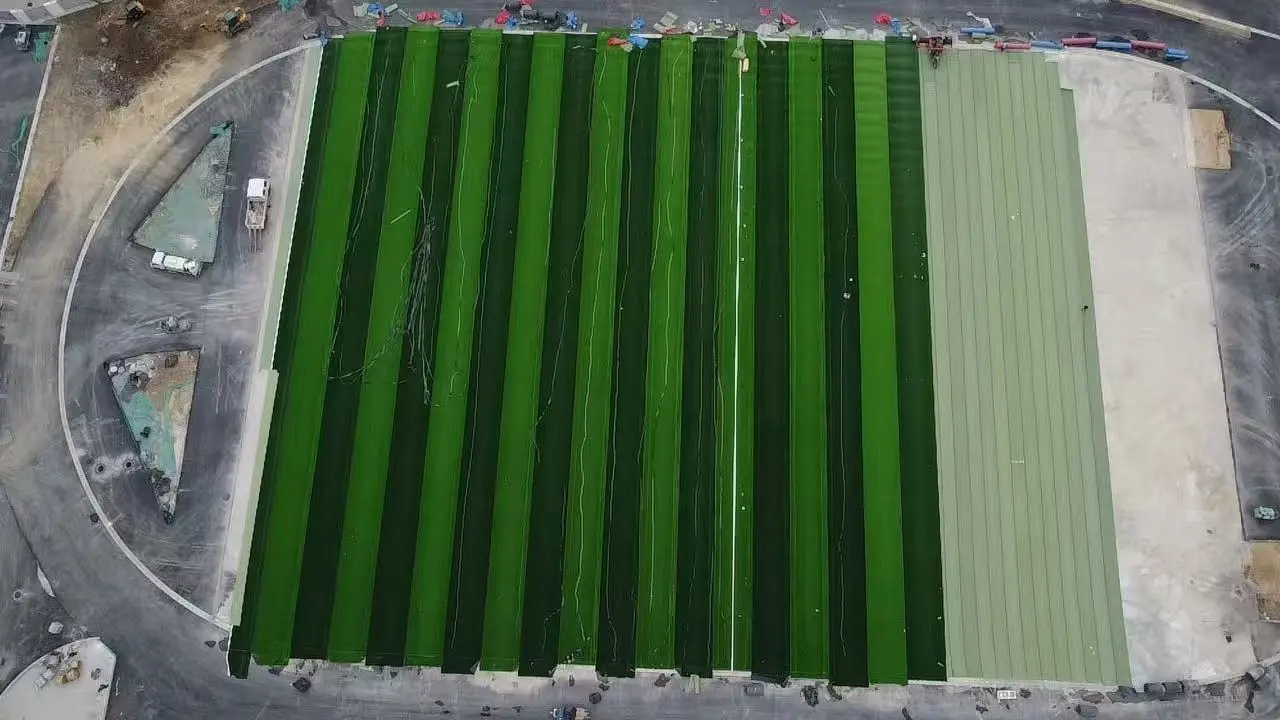
Introduction
Infilled monofilament artificial turf is widely used for football pitches, but the performance of the finished field depends on installation more than the turf itself. Base preparation, turf laying, seaming, infill installation and regular maintenance all play an important role in the final result.
Proper installation also helps maintain a uniform playing surface, good fiber appearance and long-term turf performance.
Advantages of Infilled Artificial Turf
Professional Application
Infilled artificial turf systems are widely used for football / soccer applications. Rubbers and sands infilled help support the turf fibers, stabilize the surface and provide the playing characteristics required for regular football use.
The exact infill system depends on the turf construction, pile height, yarn type and project requirements.
Excellent Resilience & Sports Performance
The rubber and sand infill improves turf stability and shock absorption, provides good ball response and comfortable footing for players.
Natural Playing Experience
Infilled artificial turf can provide a more natural-looking and consistent playing surface while keeping the advantages of artificial turf, such as durability and easier maintenance compared with natural grass.
Installation Process
The exact installation process may vary depending on the turf system, base construction and project requirements.
- Remove existing artificial turf and prepare the field
- Inspect the Football Pitch Base
- Lay Artificial Turf Rolls
- Set Out the Football Pitch
- Cut and Seam Turf
- Install Football Field White Marking Lines
- Infill the Required Rubber and Sand
- Brush and Groom the Turf
- Final acceptance check
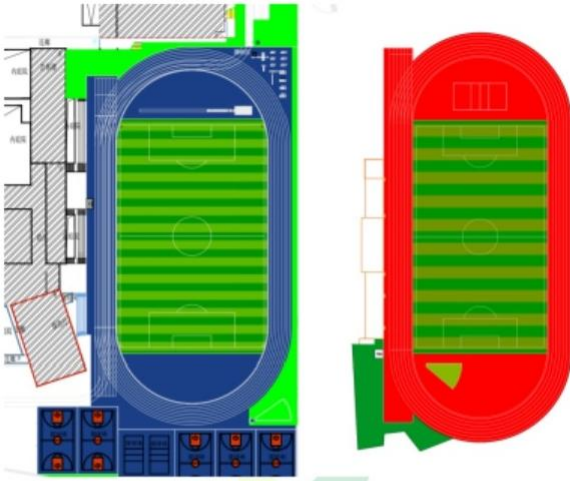
01Step 1: Remove the Existing Turf and Waste (If Any). Layout and Preparation
Remove the existing artificial turf using mechanical equipment or manual labor. All waste generated during the removal process shall be transported off-site and disposed of in accordance with applicable solid waste disposal requirements.
Based on the actual site conditions, prepare a site layout plan and review and confirm the drawings before construction.
The layout design should take into account the field dimensions, the arrangement of turf rolls, field markings, seams, and other installation details.
02Step 2: Inspect and Clean the Football Pitch Base
Check:
- Level and surface condition
- Stability and compaction
- Drainage
- Cracks, depressions or loose areas
- Debris and other foreign materials
Installation should only begin after the base has been checked and confirmed to meet the project requirements. A clean base helps the turf backing sit properly and provides a better surface for seaming and bonding.
03Step 3: Lay Artificial Turf Rolls
Arrange the turf rolls according to the installation drawings and the planned laying sequence.
Before unrolling each roll, check for:
- Damage
- Contamination
- Incorrect roll direction
- Wrinkles or folds
Unroll the artificial turf carefully and allow it to rest for several hours so that it can relax and return to its natural position before final positioning.
Keep the fiber direction consistent across adjacent rolls. Different fiber directions can create visible differences in color and appearance.
04Step 4: Set Out the Football Pitch
After laying the turf, set out the field according to the approved drawings.
Mark the main reference points, including:
- Field center point
- Buffer zone
- Large penalty area
- Small penalty area (goal area)
- Penalty spot
Accurate field layout helps keep the turf rolls, seams and field markings in the correct positions.
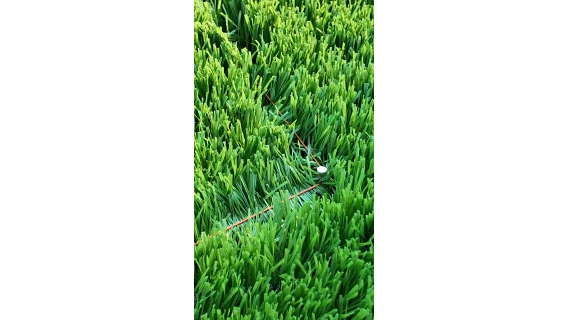
05Step 5: Cut and Seam the Artificial Turf
Turf seaming is one of the most important parts of artificial football pitch installation.
Seaming Materials:
- PET seaming tape
- Two-component turf adhesive
- Suitable turf cutting tools
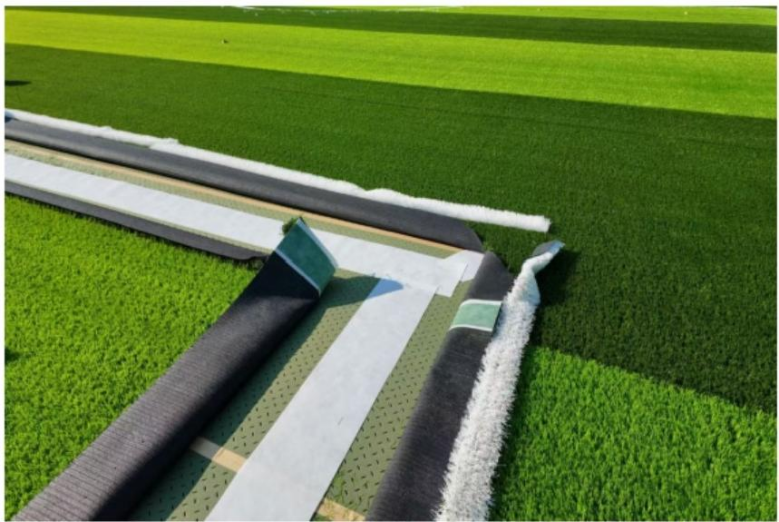
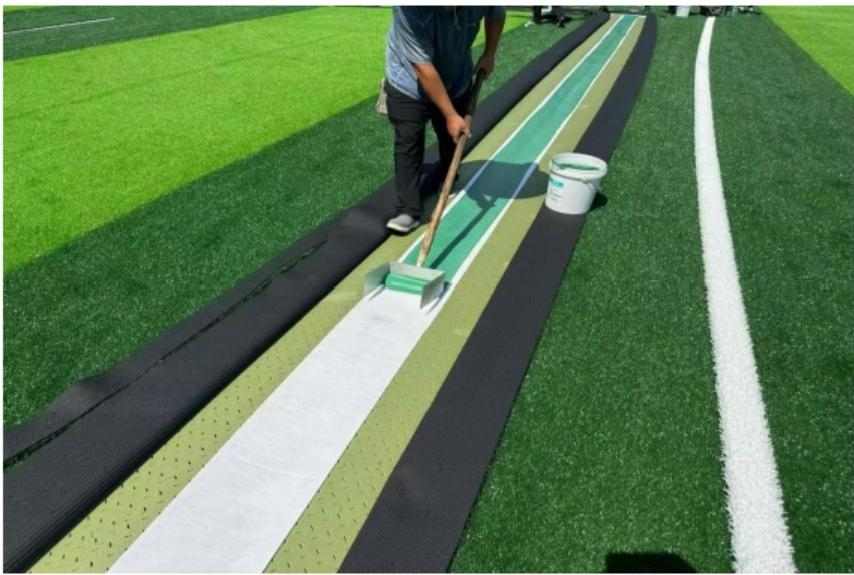
Use a cutting knife to trim the overlapping edges of turf rolls. Make sure the seaming tape is installed in the correct orientation and remains consistent along the joint.
Place PET seaming tape on the base beneath the turf joint and apply the two-component adhesive evenly.
Allow the adhesive to reach the appropriate working condition before bringing the turf edges together.
Keep the joint gap within approximately 3 mm for this installation method. A large gap can make the seam more visible after installation.
Continue seaming the green turf sections until the playing surface is fully joined.
What Makes a Good Turf Seam?
A properly installed seam should be:
- Straight
- Firmly bonded
- Evenly aligned
- Free of excessive gaps
- Free of visible adhesive
Good seam alignment is especially important in large football pitches, where even small installation errors can become more noticeable across the field.
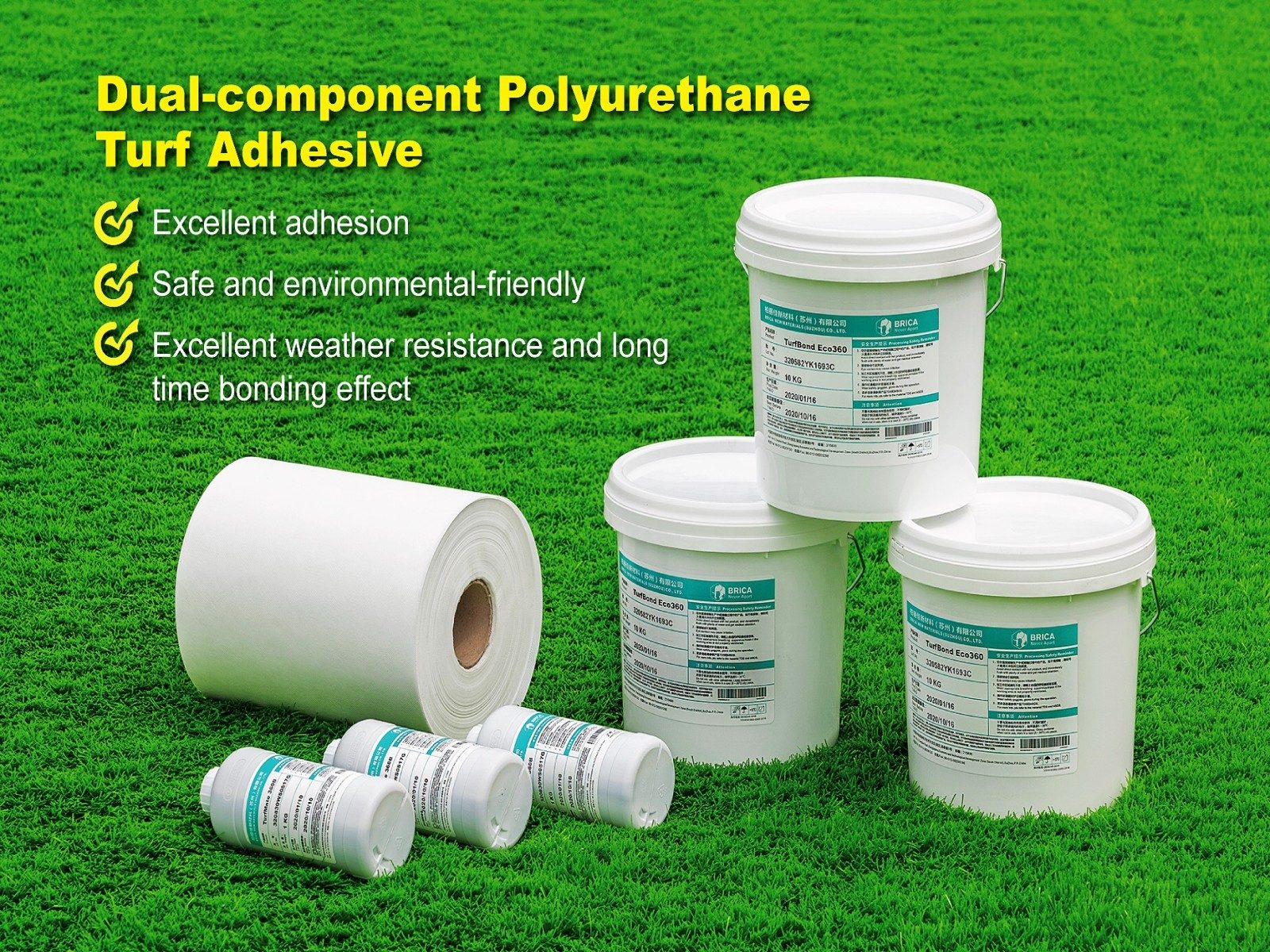 Recommended Product
Dual-Component Turf Adhesive
The two-component polyurethane adhesive used in this guide for seaming tape bonding — uniform stress distribution and high bonding strength for secure turf joints.
View Product06Step 6: Install Football Field White Marking Lines
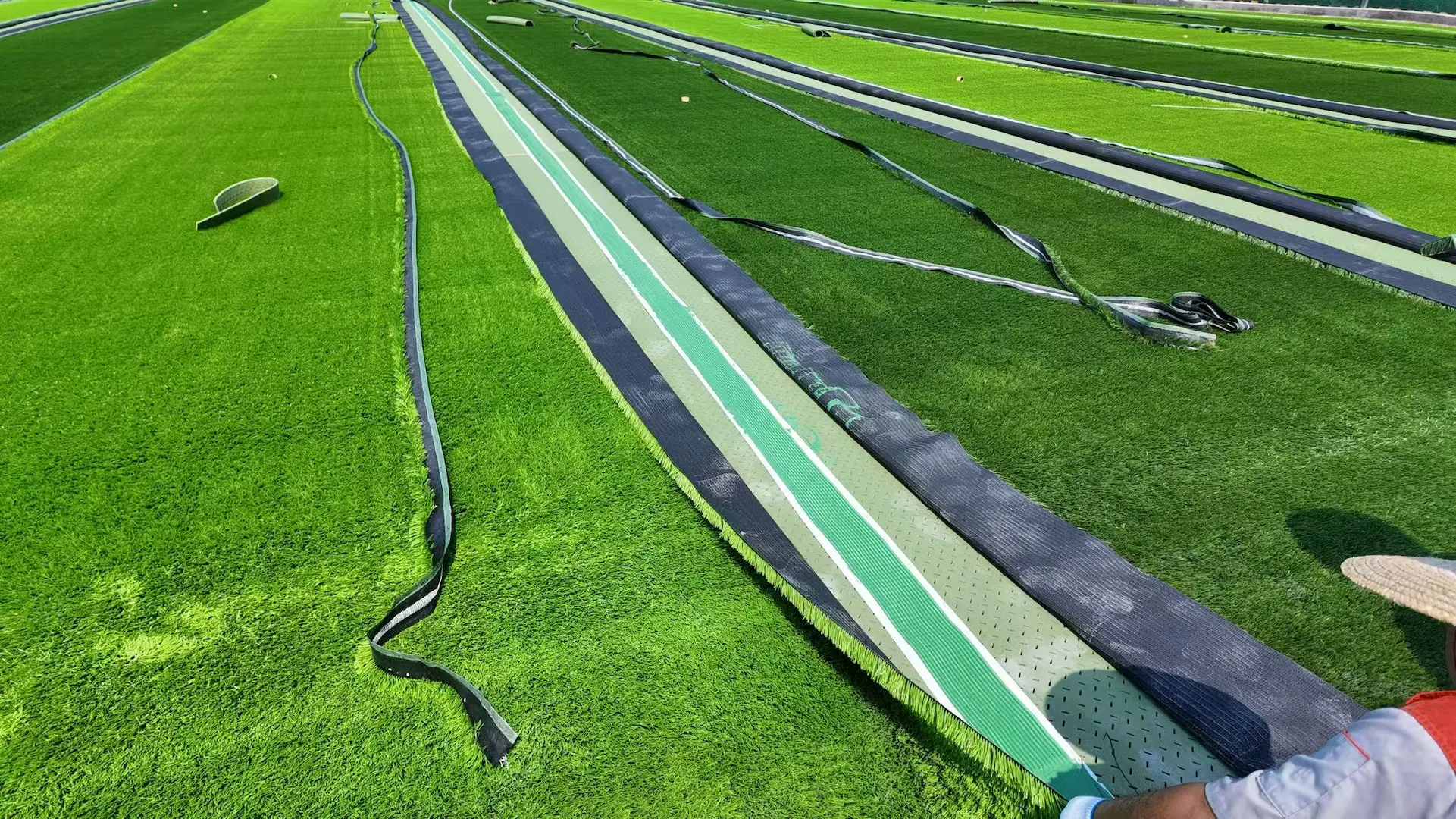
After completing the seam work on the green turf sections, install the white field markings in accordance with the approved site design drawings.
The white markings installed using this method are approximately 5 to 12 cm wide.
Field marking installation process:
- Mark the required locations for the lines.
- Cut the green turf along the marked lines.
- Remove the cut turf sections.
- Prepare the turf edges.
- Position the white marking turf.
- Apply adhesive evenly.
- Carefully align the white marking turf.
- Place appropriate weights on the seams to ensure proper bonding while the adhesive cures.
Keep the cuts straight and control the gap between the green turf and the white marking turf; typically, the gap should not exceed approximately 3 mm.
The installation of field markings must comply with the approved design drawings and the requirements agreed upon with the client.
07Step 7: Infill the Required Rubber and Sand
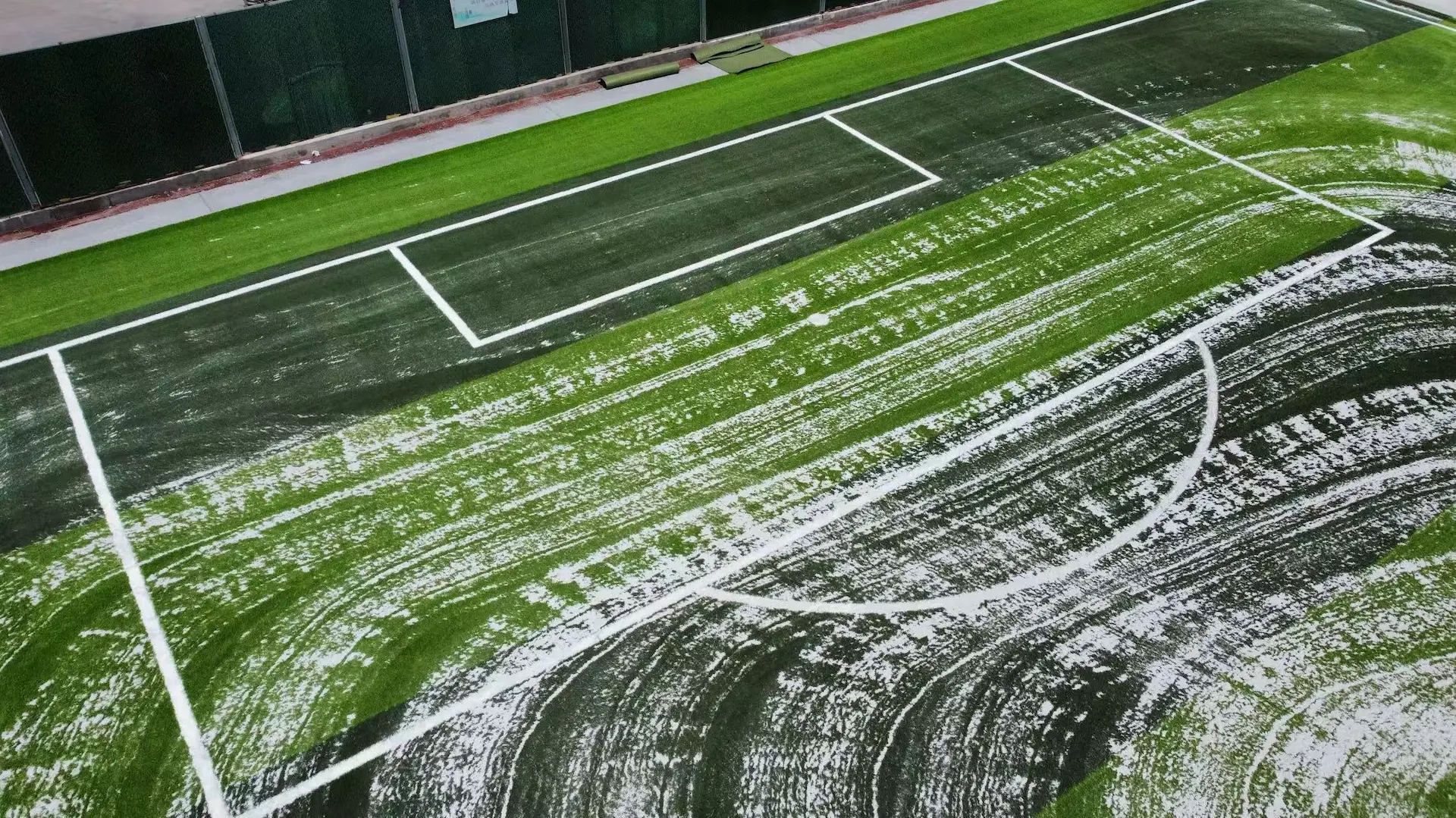
Once the turf has been fully installed and seamed, apply the required infill according to the turf system and project specification.
Quartz Sand Infill
Quartz sand is commonly used as part of sand-infilled football turf systems.
Apply the specified amount of quartz sand and brush the surface to distribute it evenly.
Rubber Granule Infill
Where required by the turf system, rubber granules can be added as an additional infill layer.
Apply and distribute the rubber granules evenly across the pitch.
The type, quantity and depth of infill should be determined according to the turf specification, playing requirements and manufacturer's recommendations.
Keys: Not every monofilament football turf system uses the same infill combination.
The appropriate infill system depends on the turf construction, pile height, yarn system, intended use and project requirements.
08Step 8: Brush and Groom the Turf
After the infill has been installed, brush and groom the turf to distribute the infill and help the fibers stand upright.
Depending on the pitch size and turf system, mechanical or manual brushing equipment can be used.
Check the surface for:
- Uneven infill
- Flattened fibers
- Visible seams
- Loose fibers
- Uneven areas
Additional brushing may be required until the infill is evenly distributed and the fibers are standing properly.
09Step 9: Final Acceptance Check
Before the football pitch is handed over, carry out a final inspection of the completed turf surface.
Turf Surface
- Overall appearance
- Fiber uprightness
- Surface uniformity
- Wrinkles or uneven areas
Seams
- Seam alignment
- Bonding quality
- Visible gaps
- Loose edges
Field Markings
- Line position
- Line width
- Alignment
- Bonding quality
Infill
- Infill distribution
- Required infill depth
- Surface consistency
After the inspection, prepare the required project documentation, clean the site and hand over the completed pitch to the client.
Prepare as-built drawings, organize the construction documents, complete the project summary and compile the required inspection and handover records.
Clean the site and remove remaining construction materials and waste before the final handover.
 Project Gallery
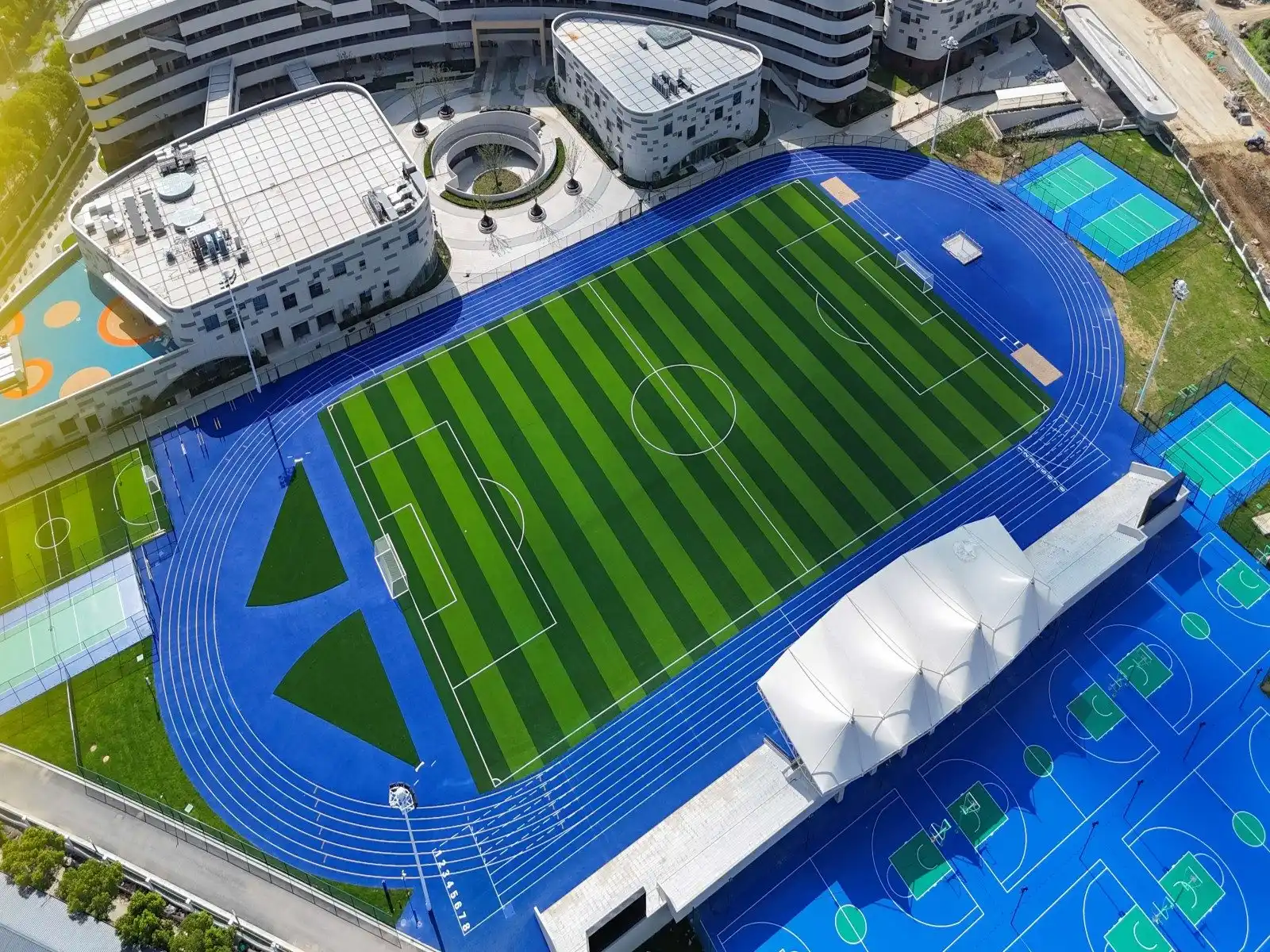
Sports Turf Projects Gallery
See how LvYin football turf systems perform in completed pitches worldwide — from school fields to professional stadiums.
View ProjectsConclusion
A football pitch is only as good as the installation behind the turf. Proper base preparation, accurate turf laying, secure seams, correctly installed field markings and even infill distribution all contribute to the finished surface.
Following the turf manufacturer's installation requirements and checking each stage before moving to the next helps ensure a clean and consistent football pitch installation.
Explore our infill football turf products or browse our sports turf projects to see completed installations.
 Recommended Product
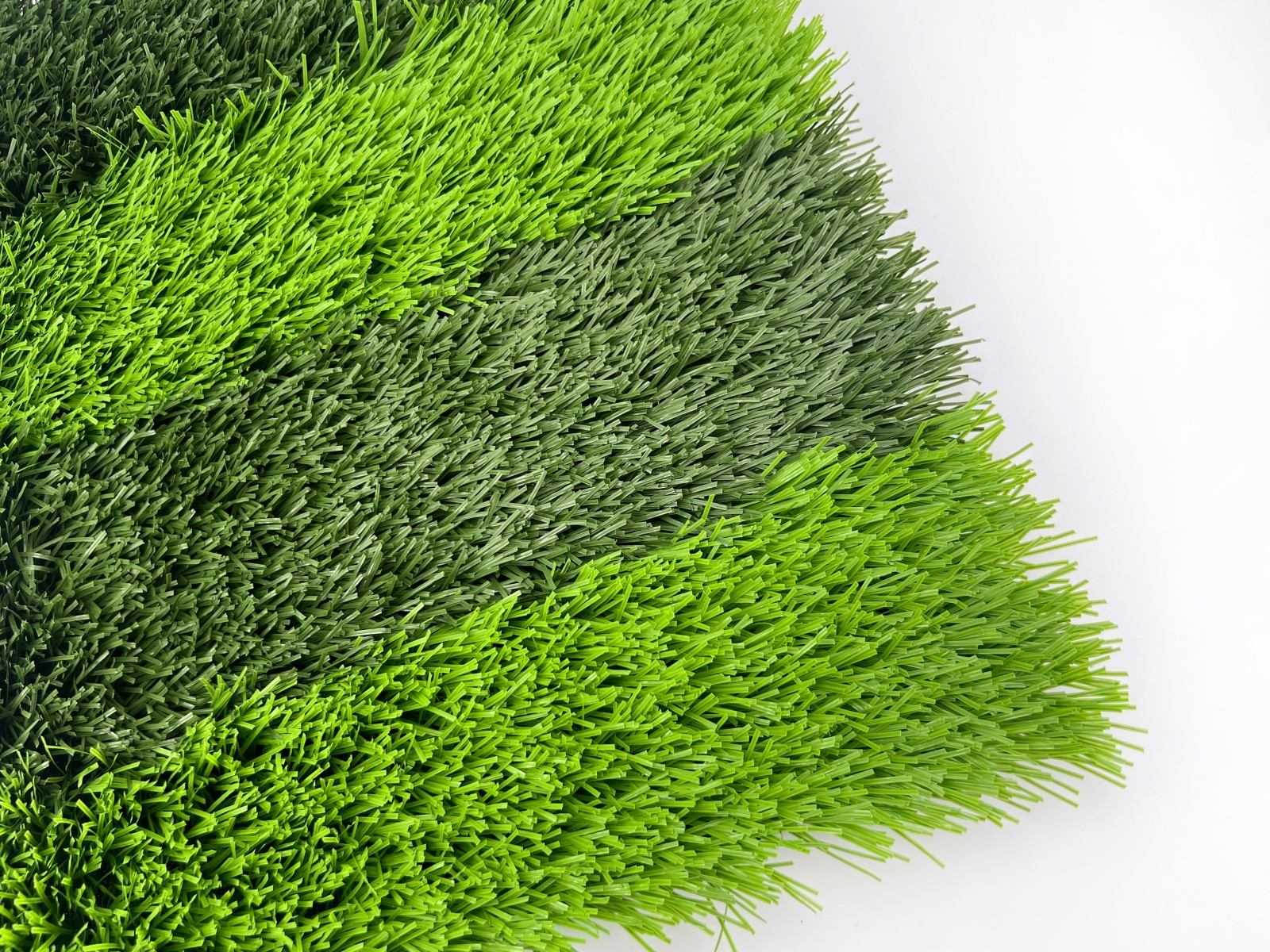
Infill Football Turf Series
Professional stem-shape and diamond-shape football turf with 40-60mm pile height — FIFA quality options for infilled football fields.
Explore Products